
Few decisions a traveler makes will reward them as generously as the decision to take one of the great Morocco trips a journey into a kingdom of staggering beauty, living history, and a culture of hospitality so genuine it disarms even the most seasoned traveler from the moment of arrival.
Every year, millions of travelers from across the world begin planning Morocco trips — and almost without exception, they return with the same report: nothing prepared them for it. Not the photographs. Not the travel articles. Not the recommendations of friends who had been before. Morocco itself, in its actual light and its actual noise and its actual generosity, exceeds every expectation the imagination is capable of constructing in advance. It is a country that does not merely impress — it inhabits. And the traveler who approaches a Morocco trip with the right preparation, the right guidance, and the right spirit of openness will find that the kingdom gives back far more than was ever asked of it.
Morocco trip planning begins with a recognition that this is not a single-destination country — it is a country of multiple worlds, each extraordinary in its own right, each requiring its own pace and its own kind of attention. The imperial cities of the north — Fez, Marrakech, Meknès, Rabat — belong to the world of medieval Islamic civilization and are among the most visually and intellectually rich urban environments on earth. The High Atlas Mountains belong to the ancient Amazigh culture of the Berber people, a world of stone villages, terraced fields, and a hospitality so unaffected it stops the traveler cold. The Saharan south belongs to a landscape so vast and so still that spending a night within it changes, in some permanent and welcome way, one’s relationship to silence. Effective Morocco trips planning means choosing which of these worlds to prioritize — and then finding a way, over ten or twelve or fourteen days, to weave between them with enough time in each to go below the surface.
“The best Morocco trips are built not around a list of sites to visit but around a quality of encounter to seek — with a civilization, a landscape, and a people whose generosity has been the defining characteristic of this kingdom for two thousand years.”
The Six Types of Morocco Trips — Finding Your Perfect Match
The range of Morocco trips available to the modern traveler is broader and more sophisticated than it has ever been. Whether you are drawn by luxury, adventure, culture, family, or budget, there is a form of Morocco trip built precisely for the way you travel.
Morocco Luxury Trips
FOR THE DISCERNING TRAVELER
Morocco luxury trips combine boutique riad stays, private guiding, exclusive cultural access, and Sahara camps where comfort never compromises immersion.
Morocco Adventure Trips
FOR THE ACTIVE EXPLORER
Morocco adventure trips deliver Atlas Mountain trekking, Sahara camel expeditions, coastal cycling, and white-water routes through gorges of extraordinary drama.
Morocco Cultural Trips
FOR THE CURIOUS MIND
Morocco cultural trips go deeper than sightseeing — artisan workshops, cooking classes, medina walks with historians, and home visits that reveal what guidebooks cannot.
Morocco Family Trips
FOR EVERY GENERATION
Morocco family trips offer camel rides, desert stargazing, pottery workshops for children, and medina treasure hunts — adventure calibrated for all ages simultaneously.
Morocco Desert Trips
FOR THE SOUL-SEEKER
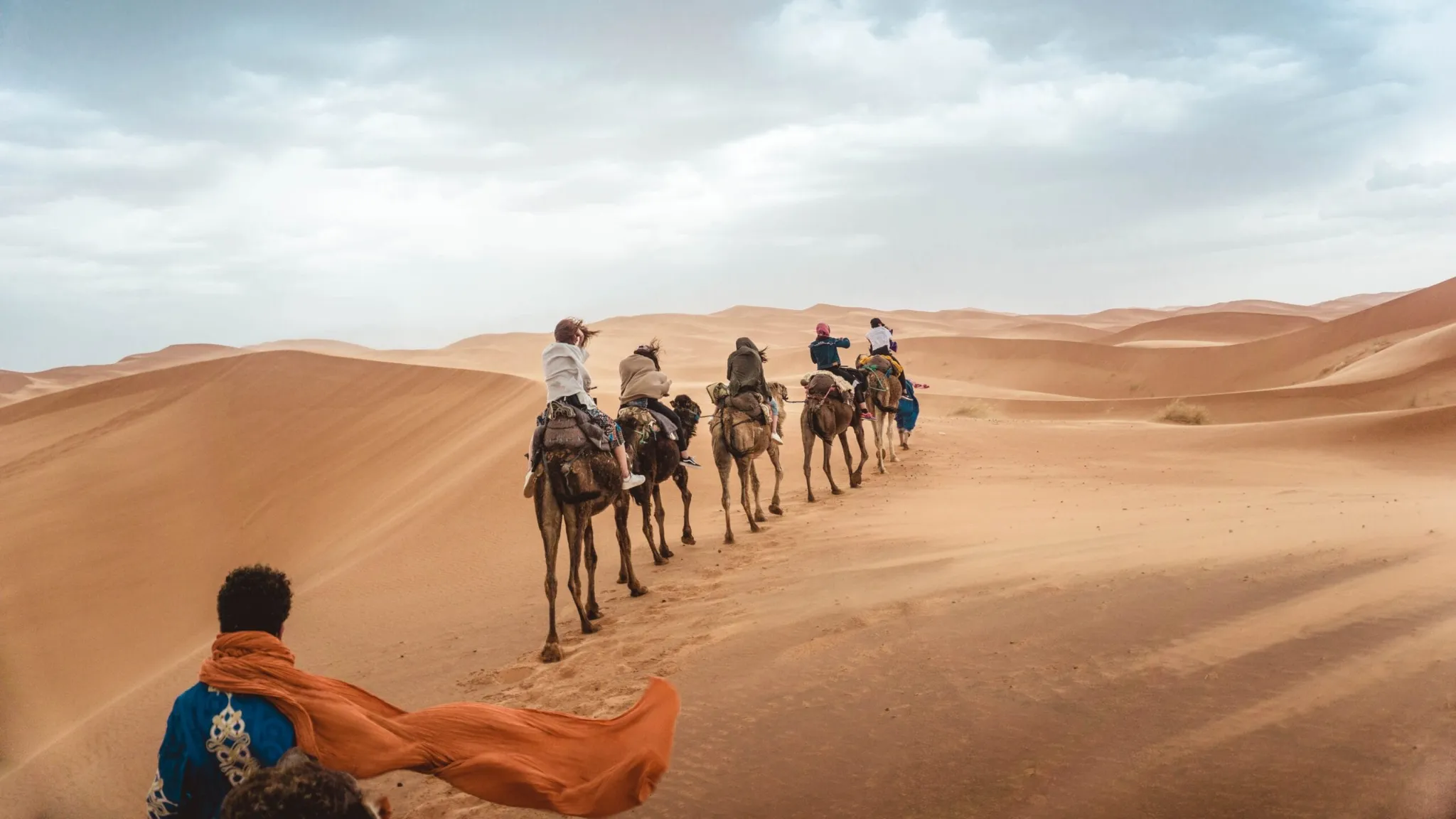
A Morocco desert trip to Erg Chebbi near Merzouga — camel caravans at sunset, Berber camp dinners, and a Milky Way sky of pure, uncompromised darkness.
Morocco Budget Trips
FOR THE SMART TRAVELER
Morocco budget trips prove that authenticity costs nothing extra — local riads, shared transport, market meals, and community-led experiences deliver extraordinary value.
Morocco Desert Trips: The Journey Every Traveler Remembers Longest
Of all the experiences that define the best Morocco trips, the desert journey consistently occupies the highest position in every traveler’s memory. A Morocco desert trip typically begins in Marrakech, crossing the High Atlas Mountains via the dramatic Tizi n’Tichka pass — at 2,260 meters, one of the great mountain roads of Africa — before descending through the rose-colored Draa Valley, past a succession of fortified kasbahs and ancient palmeries that stretch toward the horizon in every direction. This southward passage, through the Dadès and Todra gorges and across the flat hammada of the pre-Saharan plateau, is not merely transit between Marrakech and the dunes. It is, in its own right, one of the most cinematically extraordinary road journeys in the world.
At Merzouga, the Erg Chebbi dunes announce themselves with sudden, theatrical drama — copper-gold ridges climbing 150 meters above the desert floor, shifting imperceptibly with the wind, glowing in colors that change with every hour of light. The finest Morocco desert trips include at minimum two nights in a desert camp — one to absorb the sunset and the first evening star, one to wake before dawn and climb the nearest dune alone, watching the Sahara emerge from darkness into the full blaze of the Moroccan morning. This experience — simple, ancient, profoundly human — is the one that travelers on Morocco trips cite most often when asked, years later, what they remember most vividly.
The Classic Morocco Trip Itinerary: Ten Days Done Right
Effective Morocco trip planning means understanding that ten days is the minimum duration for a journey that does justice to the country’s range. The following itinerary represents the architecture of the finest ten-day Morocco trip itinerary — a structure that has been refined by professional operators over decades of experience.
1–2
DAYS
Marrakech — Arrival and Orientation
Settle into a medina riad. First evening at Djemaa el-Fna. Day two: souks, Bahia Palace, Saadian Tombs, and Majorelle Garden. Every great Morocco trip itinerary begins here.
3–4
DAYS
Atlas Mountains — Berber Village Immersion
Cross Tizi n’Tichka into the High Atlas. Overnight in a Berber village guesthouse. Mule-track walks, home-cooked tagine, authentic Amazigh hospitality. Essential to any Morocco cultural trip.
5–7
DAYS
Sahara Desert — The Heart of Every Morocco Trip
Draa Valley, Dadès Gorge, Todra Canyon, Merzouga. Two nights at Erg Chebbi — camel trek at sunset, drum circle by firelight, dawn climb of the dunes. The defining chapter of every Morocco desert trip.
8–10
DAYS
Fez — Medieval Depth and Departure
Two full days in Fez el-Bali — the tanneries, the madrasas, the souks, the Andalusian quarter. Private medina walk with a licensed guide. The intellectual culmination of the finest Morocco trips.
Morocco Trips from the UK and Beyond
One of the most compelling practical arguments for Morocco trips is the ease of access from the United Kingdom and continental Europe. Morocco trips from the UK benefit from direct flights from London, Manchester, Birmingham, Edinburgh, and Bristol to Marrakech, Casablanca, Fez, and Agadir — with journey times as short as three and a half hours on direct routes. Budget carriers including easyJet, Ryanair, and Jet2 have placed Morocco budget trips within reach of travelers who once assumed North Africa was beyond their means, while Royal Air Maroc and British Airways serve the premium traveler with full-service options on the same routes.
For Morocco group trips organized from the UK, the short flight time makes Morocco an outstanding choice for shared travel experiences — hen and stag adventures, reunion trips, corporate incentive journeys, and photography group expeditions. A Morocco group trip of eight to twelve people, guided by a specialist with deep local knowledge, moves through the country with an energy and a depth of experience that solo travel rarely matches — and the shared memories of a Saharan sunrise or a medina cooking class create bonds between participants that outlast the journey considerably.
Morocco Family Trips: A Kingdom Built for Discovery
Morocco family trips succeed because Morocco itself is a country built on the scale of human wonder — not the abstract grandeur of a museum, but the living, breathing, touchable wonder of a civilization still actively in use. Children respond to Morocco with an immediacy that adult travelers sometimes have to work to achieve: the camel is real, the dunes are climbable, the souk smells extraordinary, the tagine arrives in a clay pot that actually came from that potter’s hands in that workshop three streets away. A well-designed Morocco family trip does not simply tolerate children — it is enriched by them, because the kingdom’s hospitality extends to the young with particular warmth.